



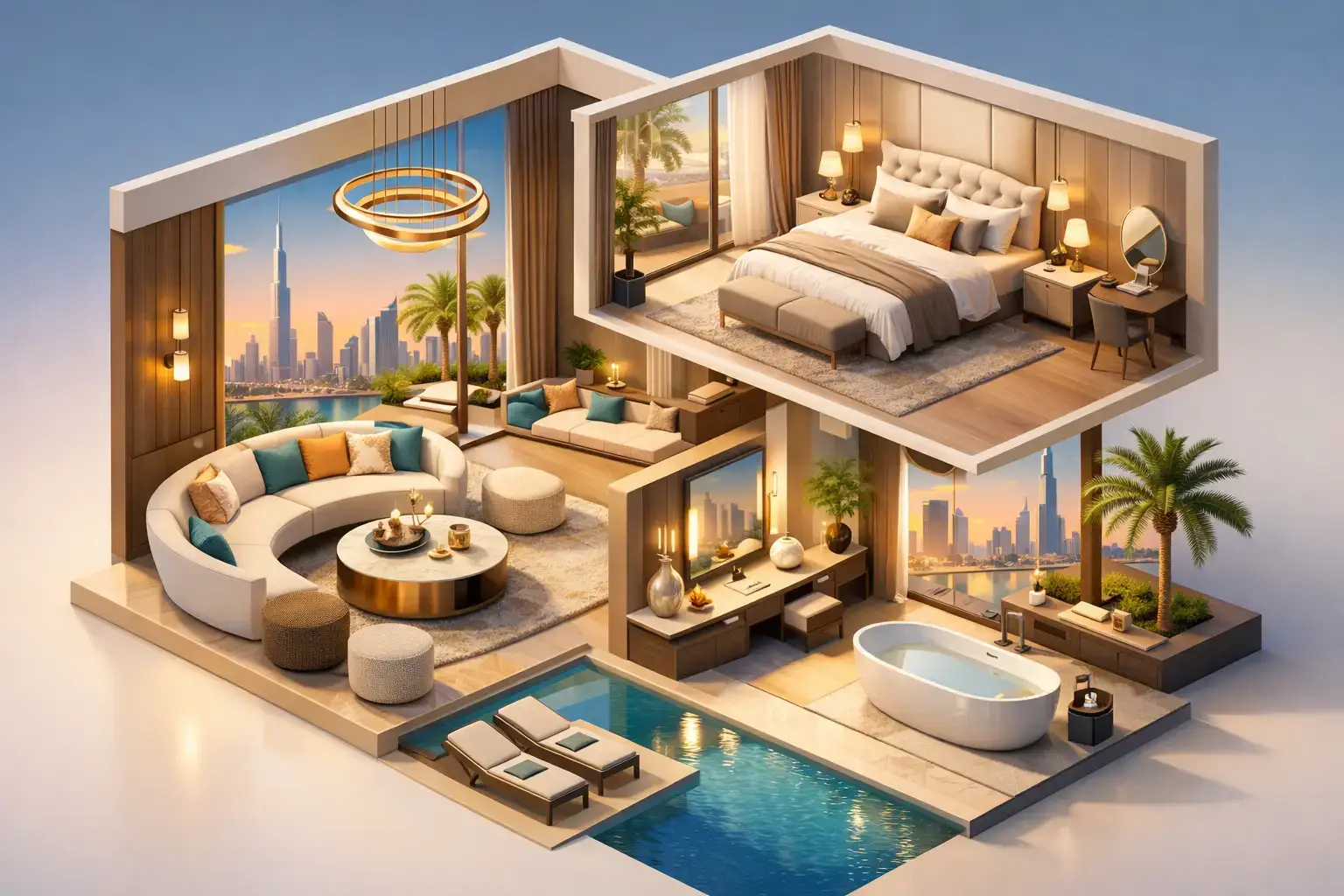
The difference between designer homes versus standard apartments is rarely about square footage alone.
The difference is evident from the very first impression. It can be seen in the architectural balance of the facade, the understated elegance of the lobby, and the intentional way natural light enhances each space. For buyers who view real estate as both a reflection of their lifestyle and a strategic investment, these details carry significant value.
While a standard apartment is designed to satisfy market demands, a designer residence is crafted to surpass expectations. This does not necessarily mean that a premium property is the right choice for every buyer.
Rather, it highlights the importance of evaluating a home through a broader perspective, one that goes beyond the price per square foot to consider quality, design, experience, and long-term value.
What designer homes versus standard apartments really means
At a glance, both property types may offer similar basics: bedrooms, parking, security, and shared amenities. The real separation lies in intent. Standard apartments are typically designed for efficiency, scalability, and mass-market appeal. They aim to serve the greatest number of buyers or tenants with a practical, familiar format.
Designer homes take a different position. They are shaped around architecture, spatial flow, material quality, and a more curated living experience. The best examples are not simply upgraded apartments with nicer finishes.
They are homes where every decision – from ceiling height to lighting layers to the feel of a door handle – is part of a larger design philosophy.
That philosophy has consequences. It affects how a home ages, how it feels to live in, and how it performs in a competitive market.
Design quality is more than decoration
Many buyers hear the word designer and think of surface-level styling. Better stone. Better cabinetry. Better staging. True design-led development goes much deeper.
A well-conceived home considers orientation, privacy, transitions between rooms, storage integration, acoustics, and the relationship between interior and exterior space. It anticipates how residents move through the home in the morning, how they entertain in the evening, and how the environment supports a sense of calm rather than visual noise.
Standard apartments often follow repeatable layouts that work adequately but rarely memorably. Hallways can feel compressed. Windows may be positioned for code compliance rather than effect. Kitchens may function but not invite use.
None of this makes them poor choices. It simply places them in a different category – one focused on utility over distinction.
For a buyer with design literacy, or even just strong instincts, the difference is immediately visible. More importantly, it remains visible years later.
The value of living experience
The strongest case for designer homes versus standard apartments is not always resale. It is daily life.
A refined home tends to create a stronger emotional response because it reduces friction. Better layouts improve circulation. Thoughtful material selection can create warmth without excess.
Privacy is often better protected, whether through lower-density planning, more intelligent window placement, or more generous separation between social and private zones.
This is where premium residential development earns its place. The home does not just house a routine. It elevates one. For professionals, entrepreneurs, and global buyers whose time is limited and standards are high, that matters. Home becomes a place that restores energy rather than consuming it.
There is also the less visible advantage of consistency. In superior developments, design excellence is supported by disciplined execution. The atmosphere of the common areas, the arrival sequence, the amenity spaces, and the landscape are all aligned.
That coherence gives a property lasting character. It also makes the difference between a residence that feels composed and one that feels assembled.
Investment performance depends on what the market values
From an investor’s perspective, standard apartments can appeal for straightforward reasons. They may have lower entry pricing, broad rental demand, and a familiar market position. In some cases, that simplicity is the point.
Designer homes, however, often compete on scarcity and desirability rather than accessibility alone. When a project offers architectural identity, stronger craftsmanship, and a more elevated resident experience, it can command greater attention from discerning buyers and tenants.
That usually matters most in markets where premium demand is deep and location strategy is strong.
This is not a guarantee of higher returns in every cycle. Premium property asks more of the buyer upfront. It also depends on execution. A developer can market design ambition, but if delivery falls short, the premium weakens quickly.
That is why developer credibility matters as much as design language. Buyers at the upper end are not purchasing a brochure. They are purchasing the confidence that quality, detail, and long-term vision will be carried through to completion.
Where standard apartments still make sense
A fair comparison needs honesty. Standard apartments are not inherently inferior. For many buyers, they are the correct choice.
If your primary goal is functional ownership in a strong location, a standard apartment may deliver exactly what you need. If you are building a diversified investment portfolio and prioritizing entry price, liquidity, or broad tenant demand, a conventional unit can perform well.
If you prefer a lower emotional premium and a more straightforward purchase decision, simplicity can be an advantage.
The trade-off is that standard inventory is easier to replicate. In crowded markets, that can make differentiation harder. When many buildings offer similar layouts, similar finishes, and similar amenity packages, pricing power may be less resilient. The home meets expectations but rarely rises above them.
Why premium buyers increasingly choose design-led homes
Luxury buyers today are rarely motivated by size alone. They want clarity of concept. They want a residence that reflects discernment, not excess for its own sake.
That shift has raised the importance of thoughtful architecture, curated materials, and stronger community planning. In a market such as Dubai, where residential choice is extensive and global standards continue to rise, buyers are becoming more selective about what truly qualifies as premium. They are asking better questions about design integrity, not just finish schedules.
This is where a brand like Esnaad Real Estate naturally enters the conversation. In design-led developments, the ambition is not to produce housing at scale without identity.
It is to shape homes with a clear point of view – homes that carry aesthetic confidence, enduring quality, and stronger long-term relevance.
For internationally minded purchasers, that has practical appeal. Distinctive homes tend to travel well across buyer profiles because design excellence is widely understood, even when tastes differ. Prestige may be local, but quality is legible everywhere.
How to tell if a home is truly design-led
The term designer is used loosely, so discernment matters. A genuinely elevated home reveals itself in proportion, planning, and restraint. It does not need to announce luxury at every turn.
Look at how spaces connect. Does the layout feel considered, or simply efficient? Study the natural light. Does it shape the home, or merely enter it? Pay attention to materials. Are they selected for longevity and atmosphere, or only immediate visual impact?
Consider the building as a whole. Is there a coherent identity from arrival to residence, or does the experience break apart in stages?
Then ask a harder question: will this home still feel relevant in five or ten years? Strong design ages with grace. Generic upgrades often date quickly.
Choosing between designer homes versus standard apartments
The smartest decision depends on what you expect your property to do for you. If you want a home that expresses personal taste, supports a more elevated lifestyle, and stands apart in the market, a designer residence is often the stronger choice.
If your priorities are practicality, flexibility, and a more accessible price point, a standard apartment may be entirely appropriate.
What matters is not buying into a label. It is understanding what sits behind it.
A home should offer more than shelter and more than status. At its best, it becomes a lasting asset with emotional intelligence – one that rewards you in the way it lives, the way it endures, and the way it is remembered.